

So let me try something different. I am going to show you what the actual research says, including the parts that make raw feeding look bad and the parts that make the cooked camp look smug. Then I will tell you where I land, and why senior pets change the maths in a way most articles never mention.
The Short Version
One Step Apart, Worlds Apart
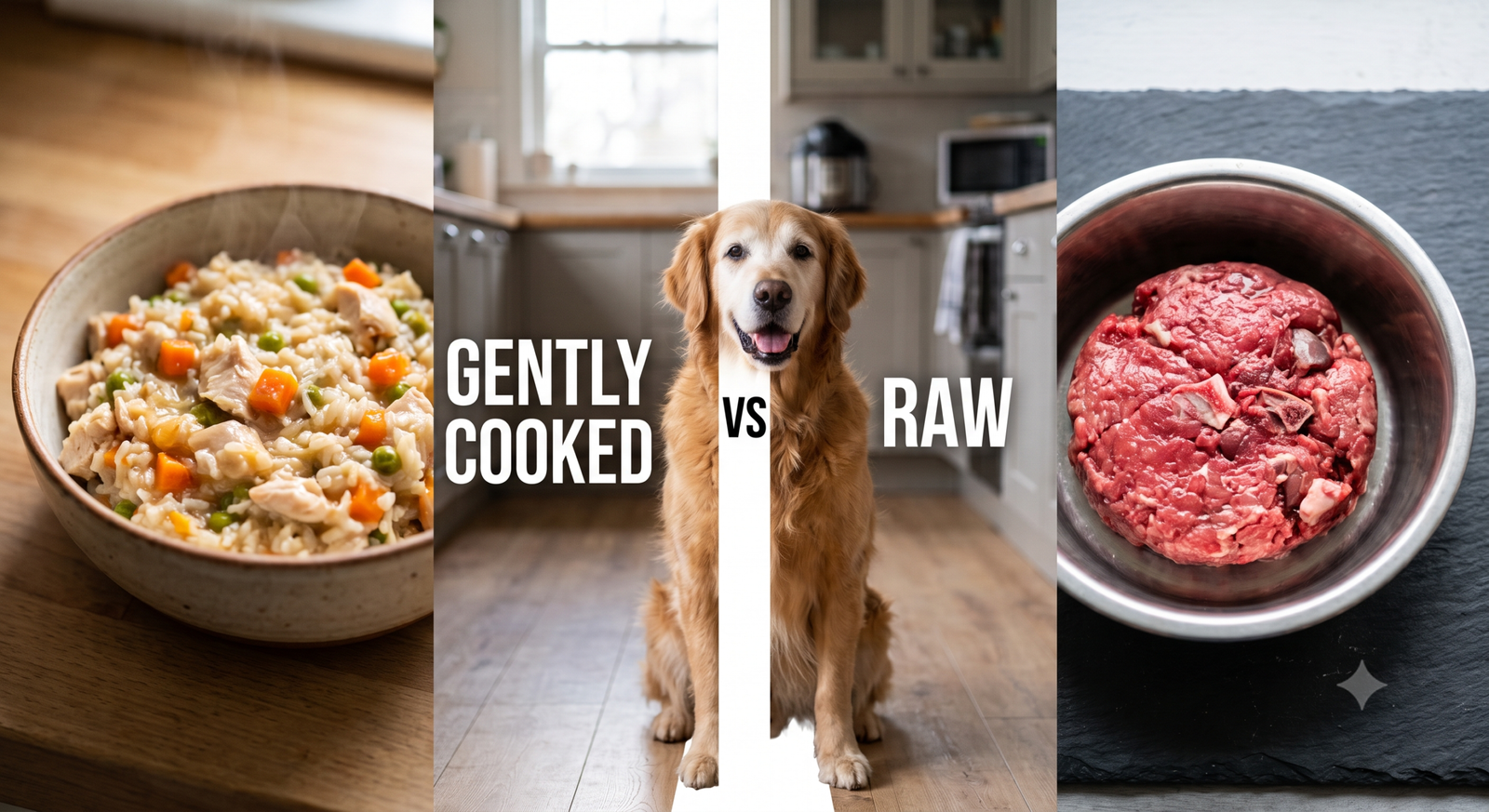
Here is what surprises people. Raw feeders and gently cooked feeders usually want exactly the same thing. Real meat you can identify. Vegetables that look like vegetables. High moisture. None of the beige extruded pellets that dominate the pet food aisle.
They are not opposing philosophies. They differ by a single step in the process.
Raw goes into the bowl uncooked. Gently cooked is heated to a temperature meant to kill common foodborne pathogens, then stopped well short of the punishing heat used to extrude kibble. That is the whole difference. One step. And that one step is where the entire safety conversation lives.
I find that framing useful because it lowers the temperature of the argument, if you will forgive the pun. Nobody in this debate is trying to harm their animal. The disagreement is narrow and specific, and narrow specific disagreements can actually be settled by looking at evidence.
What the Research Actually Found
This is where I want to be careful, because both camps quote studies at each other and most of the quoting is selective.
Start with the FDA, which ran a large sampling study of commercial pet foods. Of 196 raw pet food samples analysed, 15 tested positive for Salmonella and 32 tested positive for Listeria monocytogenes. Those numbers came from products already on shelves, sold by companies with quality control processes, not from someone grinding chicken in a garage.
The researchers were blunt about what it meant. One of the study’s principal investigators noted that a large percentage of the raw pet foods they tested were positive for Listeria monocytogenes, and the centre concluded there was a public health risk both to pets eating the food and to the people handling it.
Then there is a more recent piece of work out of Tufts, published in October 2025, which I think is the more damning of the two because of how it was designed. Researchers cultured bacteria from raw cat foods and from cooked cat foods, side by side.
Potentially dangerous bacteria grew from 42 percent of the raw cat foods and from none of the cooked ones. The organisms included Salmonella enterica, E. coli and Klebsiella. Live bacteria came out of every form of raw food tested, though frozen raw was the worst offender.
Two details from that study stuck with me. First, some bacterial strains were genetically very close to strains known to cause human infections, and one Salmonella enterica strain was identical to a strain from a reported human case. Second, the raw foods carried more genes associated with antibiotic resistance than the cooked foods did.
That second finding is the one that keeps public health people up at night, and it rarely makes it into pet blogs. We are not just talking about a bout of diarrhoea. We are talking about circulating resistant organisms through households.
Where do the major bodies stand? The AVMA discourages raw meat diets and recommends eliminating pathogens by cooking food thoroughly, generally above 160 degrees Fahrenheit. The CDC, FDA, WHO and AAHA have all reached similar conclusions. Some veterinary practices now examine raw fed animals in isolation wards with staff in full PPE, which tells you how seriously the infection control side of the profession takes it.
And the thing raw advocates most need to answer honestly: there are no peer reviewed clinical studies showing better health outcomes in pets fed raw compared with properly formulated commercial diets. The shinier coats and cleaner teeth people describe are real observations, but nobody has demonstrated them in controlled research.
Why Senior Pets Change the Calculation
Most articles on this subject could have been written about a three year old Labrador. This one is not, and the difference genuinely matters.
An aging immune system is a less effective immune system. That is true across species. A younger dog that swallows a modest dose of Salmonella will often shrug it off with a day of loose stools. A fourteen year old with early kidney disease may not.
Layer on what senior pets are frequently dealing with. Chronic kidney disease. Cancer, and the immunosuppressive treatment that comes with it. Long term steroids for arthritis or skin conditions. Diabetes. Each of these narrows the margin between an exposure the body handles quietly and one that turns into a serious illness.
There is also a nutrition problem specific to older animals. Unbalanced raw or minimally processed diets have been linked to vitamin and mineral deficiencies, poor calcium to phosphorus ratios and inadequate calories, and seniors are called out specifically as a group at heightened risk. An older cat losing muscle already does not have reserves to spare. Get the formulation wrong and you accelerate exactly the decline you were trying to prevent.
Raw bones deserve their own sentence. They can cause gastrointestinal obstruction or perforation, which is life threatening in any animal and considerably harder for an old one to survive, both the emergency itself and the anaesthetic needed to fix it.
Ten Points of Comparison
Rather than a wall of prose, work through these one at a time. Each card takes a single question, shows what the evidence says, and gives it a verdict. Use the arrows, the dots, or your keyboard.
The Honest Case for Raw
I would not trust this article if it only made one side look reasonable, so here is the strongest version of the raw argument.
Owners who feed raw report changes they did not expect. Coats that stopped looking dull. Smaller, less offensive stools. Older dogs that seemed to perk up. Cats with chronic skin irritation that settled down. These reports are numerous enough and consistent enough that dismissing them as pure placebo feels lazy to me.
They also have a legitimate structural complaint. Most of the alternative on offer is highly processed kibble, cooked at extreme temperatures and built around ingredients that would not appear in any ancestral feline diet. Pointing out that this is odd is not unreasonable. Wanting recognisable food for a carnivore is not a fringe position.
And the research gap runs both directions. Nobody has demonstrated raw diets produce better outcomes, true. But relatively little well funded research has tried, because there is no commercial incentive to run expensive trials on a diet nobody patents. Absence of evidence is not evidence of absence, and raw advocates are entitled to say so.
Where I part company with them is the leap from “kibble is over processed” to “therefore feed it uncooked.” Gently cooked exists. It answers the processing complaint without answering it with Listeria. When somebody insists raw specifically is necessary, I want to know what cooking removes that matters, and the answer usually arrives as a claim about enzymes that does not survive contact with physiology.
Where Gently Cooked Falls Short Too
The cooked camp gets smug, and I want to puncture that a little.
The label means nothing legally
There is no regulatory definition of “gently cooked.” No agency certifies that a brand using the phrase reached a temperature capable of killing Salmonella. The category is safer because cooking is safer, not because the words on the bag were audited. At least one veterinary practice groups gently cooked in with raw for infection control purposes, which strikes me as overcautious but is a useful reminder that the label is not a guarantee.
So ask. What temperature, held for how long, verified how. A company doing this properly will answer without flinching. A company that treats it as a proprietary secret has told you something.
Some nutrients do take a hit
Heat degrades certain vitamins, particularly some B vitamins and vitamin C. Gentle cooking limits this compared with extrusion, but it does not eliminate it. Well formulated products account for the loss and supplement accordingly. Homemade cooked meals frequently do not, which is how people end up with a diet that looks wholesome and quietly runs short on something important.
Homemade is where most of the real damage happens
If I had to guess where senior pets are actually being harmed by their food, it would not be commercial raw. It would be well intentioned homemade cooking that nobody formulated. Chicken and rice for a year. Human leftovers. Recipes off a forum. That is the diet that produces the deficiency case, and it is technically cooked, which lends it a false sense of safety.
How to Actually Decide
A few things I would work through in order, if this were my animal.
Start with who lives in your house. Not what your pet would prefer. Who is at the table. Anyone elderly, pregnant, very young or immune compromised shifts this decision hard toward cooked, and that includes you if you are in one of those groups. This is the step people skip and it should be first.
Then look at your pet’s actual medical situation. A healthy nine year old with clean bloodwork is a different risk profile from a fourteen year old on steroids with stage two kidney disease. Bring the bloodwork. Let the vet weigh it rather than guessing.
Ask about formulation before you ask about temperature. As above. It matters more.
Be honest about your kitchen habits. Raw feeding done properly requires separate boards, disciplined thawing, sanitised bowls after every meal and hand washing you actually do rather than intend to do. If that sounds like a lot on top of medicating an arthritic dog twice daily, that is useful information about yourself.
Change one thing at a time. Older animals do not enjoy sudden dietary revolutions. Transition over a week or two, watch the stools, watch the appetite, and if something goes sideways you will know what caused it.
Where I Land
For a senior pet, I think gently cooked is the better default, and I do not think it is a close call on the safety axis specifically.
That is not because raw feeders are careless. Most are unusually attentive owners who thought hard about this. It is because the specific vulnerability of an old animal, combined with the specific vulnerability of the people likely to be living with an old animal, removes most of the room for error that a younger household has.
If you feed raw and your pet is thriving and your household has no vulnerable members, I am not going to pretend I know your animal better than you do. Wash your hands, sanitise the bowl, skip the raw bones, and get the formulation checked.
But if you are standing at the start of this decision with a twelve year old dog and a question, the evidence points one way, and I would rather tell you that plainly than pretend the research is more balanced than it is.
Common Questions
It carries more risk for them than for younger animals. Raw meat can contain Salmonella, Listeria and E. coli, and an older immune system handles those exposures less well. Senior pets with kidney disease, cancer, diabetes or on long term steroids are more vulnerable still. An FDA study found Salmonella in 15 of 196 raw pet food samples and Listeria monocytogenes in 32 of them, so this is not a theoretical concern. Talk to your vet about your specific animal before starting raw.
No. Freezing can halt bacterial growth but it does not reliably kill Salmonella or Listeria, which survive freezing and become active again on thawing. The 2025 Tufts research found live bacteria in every form of raw cat food tested, and frozen raw was actually the most likely to grow them. Heat is what kills these organisms, which is the reason cooked products consistently test clean while raw ones do not.
It means whole ingredients heated enough to kill common foodborne pathogens but well below the extreme temperatures used to make kibble. The intent is to keep the food recognisable and moisture rich while removing the bacteria. Worth knowing: the phrase has no legal definition and no agency certifies it. Ask the manufacturer what temperature they cook to, how long they hold it, and how they verify it. A serious company will tell you.
Yes, and this is the risk owners most often overlook. A pet fed contaminated raw food sheds bacteria in saliva and stool, which spreads to bowls, floors, bedding and hands. Bacteria in raw juices also splash onto kitchen surfaces during preparation. One documented human infection was traced back to a commercial raw frozen food fed to the family dog. Risk is highest for young children, older adults, pregnant people and anyone immune compromised.
There is no peer reviewed clinical research demonstrating better health outcomes for pets fed raw compared with properly formulated commercial diets. Owners genuinely do report improvements in coat, stool and energy, and those observations deserve respect rather than dismissal, but they have not been reproduced under controlled conditions. Meanwhile the contamination evidence against raw is well documented and comes from independent bodies.
Safe from pathogens, yes, provided you cook it properly. Nutritionally complete, usually not, unless a veterinary nutritionist formulated it. Unbalanced homemade diets are linked to vitamin and mineral deficiencies, poor calcium to phosphorus ratios and inadequate calories, and seniors are specifically flagged as being at risk. Cooking solves the bacteria problem. It does not solve the formulation problem, and for an older animal the formulation problem is usually the bigger one.
Closing Thought
The raw versus cooked argument gets heated because it feels like a referendum on whether you are a good owner. It is not. Everybody in this conversation is trying to keep an animal they love comfortable for as long as possible.
What the evidence supports is straightforward: cooking removes a documented risk, and older pets in older households have less capacity to absorb that risk. That is the case, made as plainly as I can make it.
Take it to your vet with your pet’s most recent bloodwork and let them tell you what fits your specific animal. That conversation will serve you better than any article, including this one. 🐾